

Role of Recruitment and Staffing Consultancies in India
Recruitment and Staffing Consultancies are central to how modern Indian organisations attract, screen, and retain talent in a fast-changing labour market. In this long-form guide, we define what these firms do in the Indian context, explain why they matter for employers and candidates, and give practical guidance HR leaders and founders can use when selecting a partner.
Introduction to Recruitment and Staffing Consultancies in India
Recruitment and Staffing Consultancies act as intermediaries between employers and candidates, offering services that range from permanent hiring to temporary staffing, executive search, recruitment-process outsourcing (RPO), payroll administration, and advisory support. In India’s large and diverse market — spanning tier-1 metros, tier-2/3 cities and rural talent pools — these consultancies bring reach, compliance know-how, and process maturity that many in-house teams either lack or cannot scale quickly.
Key themes this article covers include talent shortages, competition for specialised skills (especially in IT/ITeS, BFSI, healthcare and manufacturing), the regulatory and compliance environment, digitalisation of hiring workflows, and how the scale and diversity of India’s workforce shape recruitment strategy. For up-to-date labour market indicators, see the Periodic Labour Force Survey (PLFS) from MOSPI and the ILO’s India Employment Report 2024.
Why Recruitment and Staffing Consultancies Matter for Indian Businesses
Businesses in India face several hiring challenges: skill gaps, regional variation in candidate supply, compliance complexity, and volatile demand (for example, seasonal hiring, contract projects, and rapid scaling in startups). Recruitment and Staffing Consultancies help mitigate these challenges by delivering time, scale, and expertise.
How Recruitment and Staffing Consultancies Reduce Hiring Time
Recruitment and Staffing Consultancies maintain candidate pipelines, proprietary databases and ATS-enabled workflows that dramatically cut time-to-fill. For fast-scaling teams — for example, a Bengaluru startup hiring engineers across machine learning, full-stack and devops — consultancies can provide targeted shortlists in days rather than weeks.
- Pre-screened candidate pools reduce preliminary interview cycles.
- Fast access to passive candidates via headhunting and networks.
- Bulk hiring frameworks for frontline roles accelerate mass onboarding.
(See the NASSCOM and Indeed reports for tech hiring trends and the role of tech platforms in speeding recruitment).
Cost Efficiency and Risk Mitigation
While agencies charge fees, the true ROI often comes from avoided costs: fewer vacancy days, reduced bad hires, lower attrition in mission-critical roles, and compliance risk reduction (e.g., correct classification of contractors vs permanent employees). Consultancies that offer payroll and statutory compliance services can help businesses avoid penalties and administrative burden.
Key Services Offered by Recruitment and Staffing Consultancies
Recruitment and Staffing Consultancies offer an array of services. Below we break down the most common offerings and their business impact.
Permanent Staffing Solutions
Permanent recruitment and staffing consultancies focuses on sourcing full-time hires for mid and senior-level roles. Services typically include:
- Job requirement definition and employer briefing.
- Sourcing across job boards, referrals, and passive channels.
- Behavioural and technical screening.
- Offer negotiation and closure support.
A quality consultancy adds value by benchmarking compensation, advising on hiring market realities, and managing candidate experience.
Temporary and Contract Staffing in India
Recruitment and Staffing Consultancies: Temporary and Contract Staffing in India
Temporary and contract staffing is a major service line for many consultancies—critical for operations that experience cyclical demand such as retail, manufacturing, events and logistics. Responsibilities include:
- Short-term deployment and payroll handling.
- Compliance with labour laws and statutory deductions.
- Rapid replacement and rotation to maintain service levels.
This model supports “payroll-on-demand” and gig-adjacent work arrangements while helping companies scale headcount up or down without long-term liability.
Executive Search and Leadership Hiring
Executive search (headhunting) is tailored, discrete and relationship-driven. Executive firms map talent markets, confidentially approach senior leaders, and assess fit for strategic leadership roles. For Indian companies entering new markets or restructuring leadership, executive search firms provide targeted access and negotiation expertise.
Recruitment Process Outsourcing (RPO)
RPO is a partnership where a consultancy becomes an extension of the client’s talent acquisition team—handling end-to-end recruitment or specific parts of the process. RPO can deliver:
- Consistent employer branding and candidate experience.
- Scalability for bulk or specialised hiring.
- Data and dashboards to improve hiring metrics.
RPO works well for organisations with chronic hiring needs (large retail chains, contact centres, IT services).
Campus Recruitment and Early Talent Programs
Consultancies support campus hiring through campus drives, assessments, and internship to full-time conversion programs—reducing administrative load on HR departments.
Bulk Hiring for Frontline Roles
For industries such as manufacturing, logistics and retail, consultancies manage campaigns for tens to thousands of hires—handling sourcing, assessment centres, documentation and induction at scale.
Payroll, Compliance and HR Advisory
Many consultancies offer payroll outsourcing, statutory compliance (PF/ESI/TDS), background checks, and HR advisory—important where in-house HR lacks bandwidth or expertise.
Role of Recruitment and Staffing Consultancies in Talent Strategy
Top consultancies act as strategic partners rather than tactical vendors. They bring market intelligence, employer branding support, and talent architecture capabilities.
Employer Branding Support
Recruitment and Staffing Consultancies help shape employer value propositions (EVP), craft job descriptions, and run candidate marketing campaigns. A credible EVP reduces offer rejections and improves long-term retention.
Talent Mapping and Market Intelligence
Consultancies conduct talent mapping to create pipelines for strategic roles—using salary benchmarking and competitor analysis to advise hiring managers. In India, where talent supply varies drastically by city and sector, this intelligence is valuable for workforce planning. For sectoral hiring trends and talent demand, consultancies often reference industry reports such as NASSCOM’s technology sector review.
Impact of Recruitment and Staffing Consultancies on Job Seekers
Recruitment and Staffing Consultancies provide tangible benefits to candidates too.
Career Guidance and Skill Matching
Consultancies offer resume feedback, interview coaching, and guidance on role fit—especially valuable for those shifting careers or entering the workforce. For freshers, the consultancy can help align academic skills with employer expectations.
Access to Hidden Job Markets
Many roles—particularly senior positions and confidential organisational changes—are filled through networks and executive search. Candidates who engage with recruitment and staffing consultancies gain access to these unadvertised opportunities.
Support for Freshers vs Experienced Professionals
- Freshers: Campus drives, assessments, training and onboarding assistance.
- Experienced professionals: Confidential searches, negotiation support, and career counselling for role transitions.
Recruitment and Staffing Consultancies in India’s Evolving Job Market
India’s labour market is in transition: post-pandemic hybrid models, rapid AI adoption, and the expansion of gig and contract work are reshaping demand.
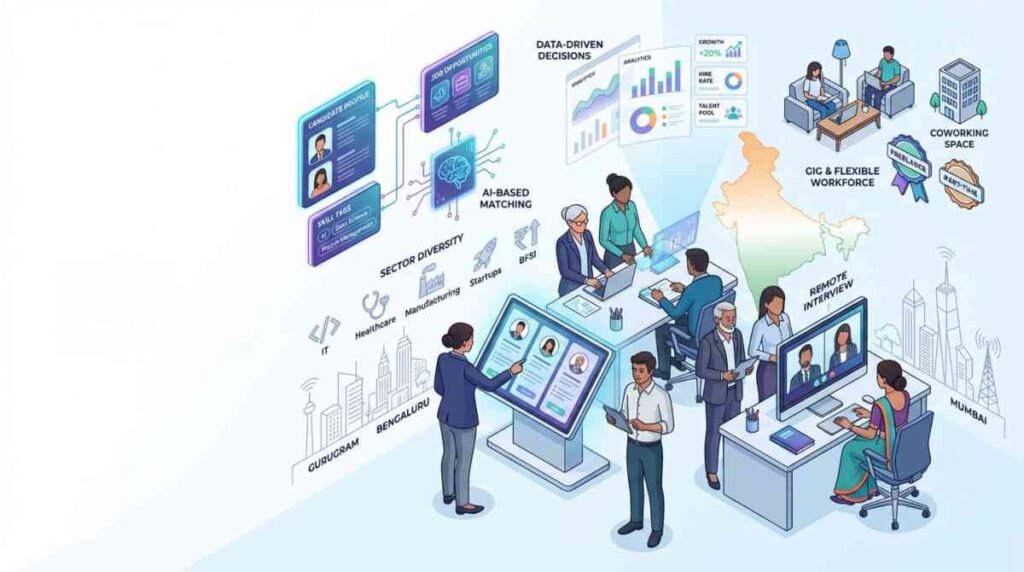
Technology, AI, and Data-Driven Hiring
Recruitment and Staffing Consultancies increasingly use Applicant Tracking Systems (ATS), AI screening tools, and data dashboards to streamline hiring. These technologies can automate CV parsing, schedule interviews, and surface high-fit candidates—freeing recruiters to focus on candidate engagement.
- The Indeed-NASSCOM Future of Work reports highlight how AI, analytics and cloud tools change hiring workflows.
- Use caution: AI should augment human judgement, not replace it—particularly to avoid algorithmic bias.
Sector-Specific Expertise (IT, Manufacturing, BFSI, Startups, etc.)
Consultancies that specialise in sectors (IT/ITeS, manufacturing, BFSI, healthcare) provide faster placements and better role-fit because they understand core skills, certifications, and cultural norms in each industry. For example:
- IT consultancies have deep networks for cloud engineers and data scientists.
- Manufacturing staffing partners deploy bulk frontline workers for plants in Gujarat or Tamil Nadu.
- BFSI specialist recruiters handle background checks and regulatory screening more efficiently.
Gig Work, Contracting and the Rise of Flexible Staffing
India is seeing significant growth in gig and platform work. Policy discussions and registries such as e-Shram and gig policy briefs from NITI Aayog show the evolving formalisation of gig work—creating opportunities for consultancies to offer compliant contract staffing solutions.
How to Choose the Right Recruitment and Staffing Consultancies Partner
Selecting a partner requires structured evaluation. Use the checklist below when assessing agencies.
Evaluating Expertise, Track Record, and Industry Fit
- Industry specialisation: Do they have deep domain knowledge for your sector?
- Client references: Request case studies and reference calls with similar companies.
- Sourcing channels: Do they use passive networks, campus pipelines and digital platforms?
- ATS and reporting: Can they provide transparent dashboards and SLAs?
Compliance, Ethics, and Data Security
- Verify background check and data handling processes—consultancies should comply with applicable data protection norms and employment laws.
- Evaluate contractual clarity around worker classification (employee vs contractor), PF/ESI obligations, and liability.
- Ask about anti-poaching clauses, candidate ownership and non-disclosure practices.
Quality of Candidate Pipeline & Turnaround Time
- Ask for time-to-first-shortlist and industry benchmarks.
- Validate the sample candidate shortlist for quality, not quantity.
- Check their ability to scale (bulk hiring) and to source niche roles (executive search).
Pricing Transparency and SLAs
- Get a clear fee structure: contingency fees, retained search, RPO pricing.
- Define SLAs for shortlist delivery, replacement guarantees, and confidentiality.
Practical Checklist (quick view)
- Industry and role expertise?
- Geographical coverage?
- Compliance & payroll services?
- Candidate quality & interview-to-hire ratio?
- Client testimonials and case studies?
- Transparent pricing and SLAs?
- Tech capability (ATS + dashboards)?
Consider running a short pilot project before committing to an RPO or retained search relationship.
Strategic Role & Value Proposition: Beyond Transactions
Top Recruitment and Staffing Consultancies partners deliver strategic value:
- Employer branding: Structured candidate journeys and market positioning.
- Talent pipelines: Ongoing talent pools reducing future hiring friction.
- Salary benchmarking: Data to inform competitive offers.
- Diversity hiring: Programs that proactively source from diverse talent pools.
- Workforce planning: Consulting on talent architectures aligned with business strategy.
A real-world example: a fast-growing fintech in Mumbai engaged a consultancy for strategic hiring. The partner delivered leadership hires, a graduate program for campus talent, and an RPO arrangement for customer support—reducing average vacancy days and lowering first-year attrition.
Technology & Trends Affecting Recruitment and Staffing Consultancies
ATS, Job Portals and Professional Networks
Modern consultancies integrate with job portals, LinkedIn Recruiter, and niche talent communities to increase reach. They also implement ATS for consistent candidate tracking and compliance.
AI-Driven Screening and Matching (Pragmatic View)
AI applications are now common—resume parsing, initial screening, and skill matching. However:
- Use AI for efficiency, not sole decision-making.
- Ensure human oversight for final interviews and culture fit checks.
- Regularly audit AI models for fairness and bias.
Data Analytics and Dashboards
Data dashboards show funnel metrics (applications → interviews → offers → acceptances), helping clients optimise job descriptions, sourcing channels, and compensation offers.
Remote Work and Hybrid Hiring
Remote and hybrid job models expand talent pools beyond local geographies. Consultancies help employers evaluate remote-ready candidates, set compensation bands, and implement onboarding processes for distributed teams.
India-Specific Considerations and Examples
Workforce Diversity and Geography
India’s workforce is diverse—across education levels, languages, and urbanisation. A hiring strategy for a Tier-1 city (e.g., Bengaluru) differs from one for Tier-2 or Tier-3 centres. Consultancies with pan-India presence offer local sourcing advantages and localized candidate engagement.
Regulatory and Compliance Nuances
Indian labour regulations and statutory deductions (PF, ESI, professional tax) vary by state and employment type. Consultancies with payroll capabilities reduce compliance risk for employers and help manage contractor classification.
For authoritative employment statistics and labour indicators, consult MOSPI’s PLFS and government labour portals.
Sector Growth Examples
- IT/ITeS (Bengaluru, Pune, Hyderabad): Demand for cloud, security and AI skills. See NASSCOM’s sector reviews.
- Manufacturing (Gujarat, Tamil Nadu): Bulk frontline hiring and skilling for shop-floor roles.
- BFSI (Mumbai, Gurugram): Need for compliance-aware recruitments and background verification.
- Startups (Bengaluru, Mumbai, NCR): Rapid hiring for product-market fit phases requiring flexible staffing solutions.
Practical Hiring Scenarios — How Consultancies Add Value
Scenario 1: Fast-Scaling Tech Startup in Bengaluru
Problem: Need 30 engineers in 60 days with specific ML skills.
Consultancy Actions: Talent mapping, targeted headhunting, campus programme for junior roles, RPO for continuous hiring. Result: Reduced time-to-hire, stronger offer acceptance through better market data.
Scenario 2: Manufacturing Plant in Gujarat
Problem: Seasonal demand for 500 operators and supervisors.
Consultancy Actions: Bulk hiring campaigns, onboarding drives, payroll and statutory compliance, local language screening. Result: Rapid scaling without compliance headaches.
Scenario 3: BFSI Leadership Hire in Mumbai
Problem: Confidential search for Head of Risk.
Consultancy Actions: Executive search, discreet approach to passive candidates, compensation benchmarking. Result: High-quality shortlist and shorter negotiation cycles.
How Recruitment and Staffing Consultancies Support the Broader Ecosystem
- Formalisation of employment: By converting informal hiring into documented contracts and payroll, consultancies support labour formalisation.
- Bridging skills gaps: Through upskilling partners and curated training programs in collaboration with clients.
- Supporting SME and startup growth: SMEs often lack in-house TA capability; consultancies provide plug-and-play talent solutions.
For macro perspectives on employment and youth skills, refer to the ILO and India Employment Report 2024.
Future of Recruitment and Staffing Consultancies in India
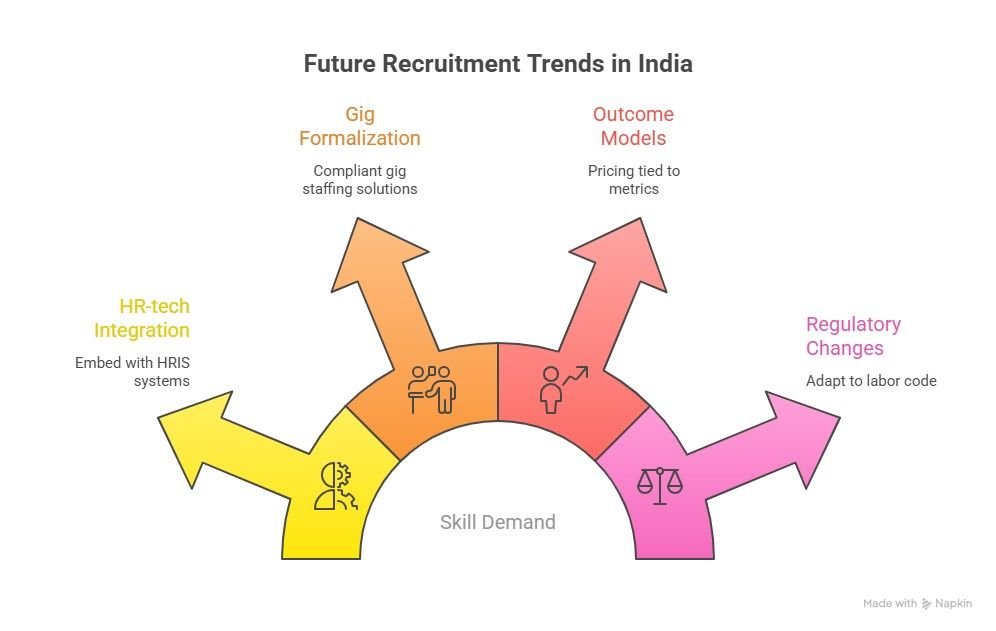
Looking forward, the ecosystem will evolve along several axes:
- Higher demand for specialised skills: AI, cybersecurity, and green-tech talent will be in demand.
- Deeper HR-tech integration: Consultancies will embed with HRIS, payroll and performance systems.
- Formalisation of gig and contract work: Expect more compliant gig staffing solutions and social security linkages.
- Outcome-based staffing models: Clients may demand pricing tied to retention or productivity metrics.
- Regulatory changes: Future labour code clarifications and social security policies for gig workers could reshape contract staffing—consultancies will need to adapt quickly. For background on gig policy evolution, see NITI Aayog and related policy briefs.
How to Measure Consultancy Performance (KPIs)
When working with a consultancy, track measurable KPIs:
- Time-to-first-shortlist and time-to-hire.
- Interview-to-offer and offer-to-acceptance ratios.
- 90-day and 1-year retention of hires.
- Cost-per-hire and hiring process cost savings.
- Candidate Net Promoter Score (cNPS) as a quality proxy.
Regular reporting aligned to these KPIs ensures accountability and continuous improvement.
Practical Checklist Before Engaging a Consultancy
- Define the scope: retained search, contingency, RPO, payroll?
- Ask for a pilot or proof-of-concept for critical roles.
- Request sample candidate dashboards and SLAs.
- Verify legal/compliance capabilities for state-specific labour laws.
- Negotiate replacement guarantees and confidentiality clauses.
- Agree on reporting cadence and success metrics.
Internal Resources & Further Reading (Internal Links)
- Learn more on strategic workforce design in our guide: Strategic Workforce Planning in India.
- For analysis of flexible hires and benefits, see: The Benefits of Contract Staffing.
- Explore our advisory services: HR Consulting Services in India.
External Resources & Industry Reports
- Periodic Labour Force Survey (PLFS) — MOSPI (labour indicators and trends).
- India Employment Report 2024 — ILO (youth employment and skills).
- NASSCOM — Technology sector reviews and hiring trends in IT/ITeS.
- Indeed-NASSCOM Future of Work 2024 — recruitment, AI and hiring insights.
- NITI Aayog / policy briefs on the gig economy (context on contract work in India).
Conclusion
Recruitment and Staffing Consultancies are strategic partners that help Indian organisations navigate a large, diverse and dynamic labour market. They reduce time-to-hire, provide access to passive and niche talent, manage compliance risk, and deliver talent intelligence that supports scaling and transformation. For job seekers, they open doors to hidden roles and provide career guidance. As technology, hybrid work and gig arrangements continue to reshape hiring, consultancies that combine domain expertise, ethical use of technology, and strong local knowledge will be the most valuable partners for Indian businesses.
If you’re an HR leader or founder in India evaluating partners, begin with a small pilot, prioritise consultancies with a demonstrable track record in your sector, and measure performance with clear KPIs. The right recruitment partner can be the difference between missed opportunity and accelerated growth.