

Digital marketing is a booming field, and professionals often face a choice: work as a full-time employee in a company or pursue freelancing in digital marketing. Both paths offer opportunities for growth, learning, and career development. However, freelancing in digital marketing provides unique advantages for those who seek freedom, flexibility, higher earning potential, and independence. This article explores what freelancing in digital marketing is, how it differs from a traditional digital marketing job, and why it may be a better path for ambitious professionals.
What is Freelancing?
Freelancing is a type of work where a person offers their skills or services to clients independently rather than being employed full-time by a single company. Freelancers work on a project-by-project basis, managing their own schedules, client relationships, and payments.
Unlike traditional employees, freelancers are their own boss. They have the power to decide:
- Which projects to work on
- Who to work with (clients)
- How much to charge
- When and where to work
Freelancing can cover a wide range of fields including writing, graphic design, web development, video editing, programming, consulting, and most importantly, digital marketing.
What is a Digital Marketing Job?
A digital marketing job refers to working as an employee for a company, performing tasks like SEO, social media management, email marketing, content creation, and paid advertising campaigns.
Key Features of a Digital Marketing Job
- Fixed salary and working hours
- Assigned responsibilities from a manager
- Learning limited to the company’s projects
- Steady career growth and job security
For example, a digital marketing executive in a retail company may only manage Instagram campaigns and track ad performance, without exposure to SEO, email marketing, or content strategy beyond the company’s scope. While this provides stability, the learning curve may be slower compared to freelancing in digital marketing, which exposes professionals to a broader range of skills and challenges

What is Freelancing in Digital Marketing?
Freelancing in digital marketing involves offering your digital marketing services independently to multiple clients. Freelancers are responsible for managing projects, setting schedules, and determining rates while delivering results that meet client expectations.
Key Features of Freelancing in Digital Marketing
- Work independently for multiple clients
- Flexible schedule and remote opportunities
- Set your own rates and earnings
- Exposure to diverse industries and projects
For example, a freelancer may simultaneously manage social media for a restaurant, SEO for an e-commerce brand, and email marketing for a tech startup. This variety accelerates learning, enhances creativity, and helps develop a strong portfolio—benefits rarely experienced in a single corporate job.

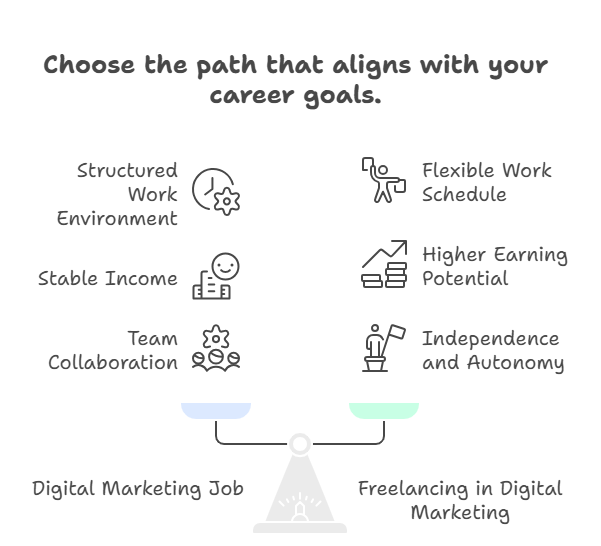
Key Differences Between Digital Marketing Jobs and Freelancing
| Feature | Digital Marketing Job | Freelancing in Digital Marketing |
| Employment | Works for one company | Independent professional |
| Income | Fixed salary | Variable, project-based |
| Schedule | Fixed working hours | Flexible, self-managed |
| Clients | One employer | Multiple clients globally |
| Skill Exposure | Limited to company tasks | Diverse projects across industries |
| Career Growth | Slow, hierarchical | Fast, depends on effort & skill |
| Freedom | Limited | High, choose projects & clients |
| Job Security | More stable | Depends on client base |
These differences highlight why freelancing in digital marketing is ideal for those seeking flexibility, rapid growth, and the ability to work on multiple projects that align with their interests.
Benefits of Freelancing in Digital Marketing
In the digital era, freelancing in digital marketing has become a popular career choice for professionals who want independence, creativity, and financial growth. Here’s why:
1. Flexibility in Work Hours
One of the most significant benefits of freelancing in digital marketing is the ability to work on your own schedule. Unlike a traditional 9-to-6 digital marketing job, freelancers can plan their workday according to personal commitments, peak productivity hours, and preferred routines.
For example, a freelance social media marketer might schedule content creation late at night when there are fewer distractions or conduct client calls in the morning. This flexibility improves work-life balance and reduces stress, allowing professionals to manage multiple projects efficiently.
2. Higher Income Potential
Freelancers often earn more than salaried employees because their income depends on the number of clients, projects, and expertise rather than a fixed pay scale.
For instance, a freelance SEO specialist handling five projects per month at $300 per project can earn $1,500—a figure that may exceed the salary of a junior digital marketing employee. Over time, as a freelancer gains experience and a strong client base, rates can increase significantly, sometimes earning 2-3 times more than a traditional job.
3. Freedom to Choose Projects and Clients
With freelancing in digital marketing, you can pick projects and clients that interest you. This ensures your work is aligned with personal goals and creative preferences.
For example, a content marketing freelancer may choose to work exclusively with eco-friendly brands or tech startups. In contrast, employees are often assigned tasks that may not align with their interests, limiting creative satisfaction.
4. Location Independence and Remote Work
Freelancers are not tied to office locations or commuting schedules. Freelancing in digital marketing allows professionals to work from home, co-working spaces, or even while traveling.
This location flexibility opens up global opportunities. For instance, a digital marketing freelancer in India can manage campaigns for clients in the USA, UK, or Australia, gaining international exposure and higher-paying projects.
5. Accelerated Skill Development
Freelancers work across multiple clients and industries, which accelerates skill development. Unlike a traditional job where tasks are repetitive and limited, freelancing in digital marketing exposes professionals to diverse challenges.
For example, handling SEO for an online store, social media for a restaurant, and email marketing for a SaaS company in one month allows rapid learning of different strategies, tools, and industries. This variety enhances problem-solving skills and makes freelancers highly versatile.
6. Creative Freedom
In a traditional job, strategies are often dictated by company guidelines. Freelancing in digital marketing allows professionals to experiment, innovate, and implement their ideas independently.
This creative freedom increases satisfaction, encourages innovation, and helps freelancers showcase unique solutions to clients, often leading to long-term partnerships.
7. Building a Personal Brand and Portfolio
Unlike employees, freelancers build their own reputation. Freelancing in digital marketing allows professionals to create a strong portfolio, showcasing successful projects and attracting more clients.
For instance, a freelance graphic designer who consistently delivers social media campaigns can display work on Upwork, Fiverr, or LinkedIn. A strong portfolio becomes a personal asset, generating recurring projects and long-term career stability.
8. Better Work-Life Balance
Freelancing in digital marketing enables professionals to balance personal life and work. Freelancers can allocate time for family, hobbies, travel, or education, reducing burnout and improving overall well-being.
For example, a freelancer may dedicate mornings to client work, afternoons to learning new marketing tools, and evenings to personal time—a flexibility rarely available in corporate jobs.
9. Diverse Exposure to Industries
Freelancers often handle projects across different sectors, gaining exposure that employees rarely experience. Freelancing in digital marketing allows professionals to understand varied audiences, marketing trends, and business models.
A freelancer managing campaigns for a clothing brand, tech startup, and restaurant simultaneously develops a broader perspective than someone focused on a single company. This cross-industry knowledge increases versatility and employability.
10. Independence and Career Control
Finally, freelancing in digital marketing gives professionals complete control over their career. Freelancers decide which clients to work with, what projects to take, how much to charge, and which skills to develop.
This independence allows scaling income, specializing in high-demand areas, and creating long-term career growth without relying on company hierarchies. Over time, a freelancer can achieve financial freedom and professional satisfaction beyond the limitations of a traditional job.

Conclusion
Freelancing in digital marketing offers unmatched freedom, flexibility, and growth opportunities compared to traditional digital marketing jobs. While a salaried position provides stability, structure, and a predictable income, freelancing allows professionals to choose projects, work remotely, earn more, and accelerate their skills.
For ambitious digital marketing professionals who value independence, creativity, and the ability to grow at their own pace, freelancing in digital marketing is a highly rewarding career path. From building a personal brand to gaining global exposure, freelancing in digital marketing opens doors to opportunities that a traditional job cannot match.
In today’s world, starting freelancing in digital marketing can be the first step toward financial freedom, professional growth, and a fulfilling career tailored to your skills and interests.