

SQL for Data Analytics
In today’s data-driven world, businesses rely on data to make informed decisions, improve customer experiences, and increase profitability. From small startups to multinational corporations, data analytics has become a crucial part of business operations. If you are planning to build a career in data analytics, one skill stands above the rest—SQL for Data Analytics: Why Every Beginner Should Learn It.
SQL (Structured Query Language) is the foundation of data analytics. Whether you want to become a Data Analyst, Business Analyst, Data Scientist, or Marketing Analyst, learning SQL can open the door to countless career opportunities. In this blog, we will explore SQL for Data Analytics: Why Every Beginner Should Learn It, its benefits, applications, and how it can help beginners start their journey in the analytics industry.
What is SQL?
Before understanding SQL for Data Analytics: Why Every Beginner Should Learn It, let’s first understand what SQL is.
SQL stands for Structured Query Language. It is a programming language used to manage, retrieve, manipulate, and analyze data stored in relational databases. SQL helps users interact with databases by writing queries that can fetch specific information from large datasets.
For example, a company may store customer information, sales records, and employee data in databases. SQL allows analysts to extract meaningful insights from this information quickly and efficiently.
Understanding SQL for Data Analytics: Why Every Beginner Should Learn It
Data analytics is all about collecting, cleaning, analyzing, and interpreting data. Since most business data is stored in databases, SQL becomes the primary tool for accessing that information.
The reason SQL for Data Analytics: Why Every Beginner Should Learn It is so important is that SQL helps professionals:
- Access data directly from databases
- Filter and organize large datasets
- Perform calculations and aggregations
- Generate reports
- Support business decision-making
- Identify trends and patterns
Without SQL, working with large amounts of data becomes much more difficult.
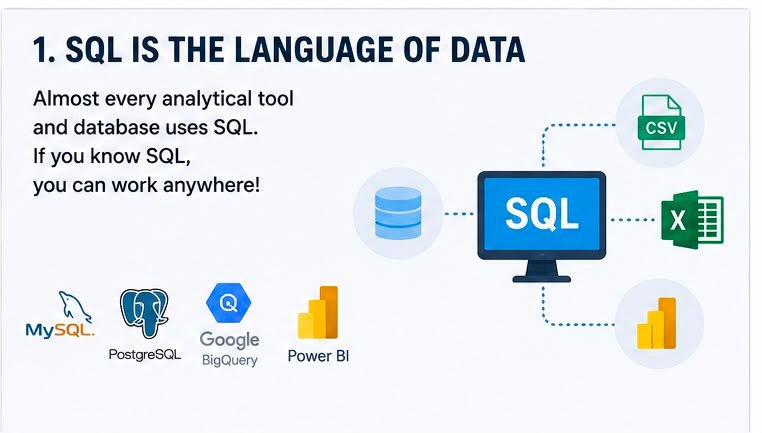
SQL is the Most In-Demand Skill in Data Analytics
One of the strongest reasons behind SQL for Data Analytics: Why Every Beginner Should Learn It is industry demand.
Almost every data-related job description includes SQL as a required skill. Employers expect candidates to know how to retrieve and analyze data from databases.
Common job roles requiring SQL include:
- Data Analyst
- Business Analyst
- Data Scientist
- Financial Analyst
- Marketing Analyst
- Product Analyst
- Operations Analyst
Learning SQL can significantly improve your employability and make your resume stand out in a competitive job market.
SQL is Easy for Beginners to Learn
Another important aspect of SQL for Data Analytics: Why Every Beginner Should Learn It is its beginner-friendly nature.
Unlike many programming languages, SQL uses simple English-like commands. Some common SQL commands include:
- SELECT
- FROM
- WHERE
- ORDER BY
- GROUP BY
- JOIN
For example:
SELECT customer_name
FROM customers
WHERE city = ‘Delhi’;
Even someone with no coding experience can understand what this query does.
This simplicity makes SQL one of the easiest technical skills for beginners to learn.
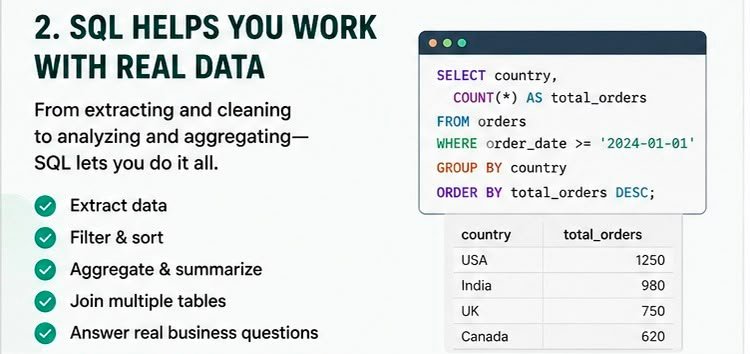
SQL Helps You Work with Real Business Data
A major reason behind SQL for Data Analytics: Why Every Beginner Should Learn It is that SQL provides direct access to real-world business data.
Organizations store critical information in databases such as:
- Customer details
- Sales transactions
- Inventory records
- Website traffic data
- Financial reports
- Employee information
By learning SQL, beginners can explore actual business datasets and understand how companies use data to make strategic decisions.
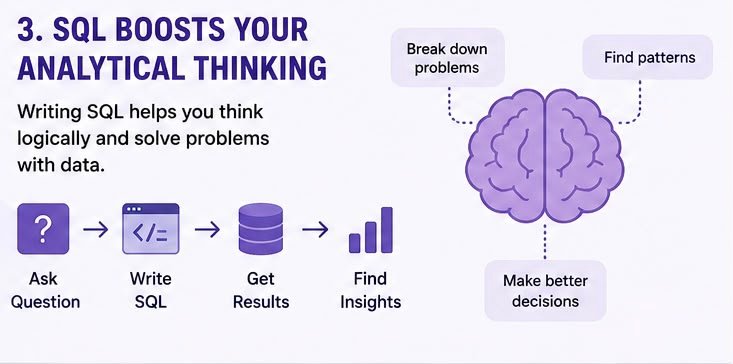
SQL Improves Data Analysis Efficiency
Data analysts often deal with millions of records. Manually analyzing such large datasets is impossible.
This is where SQL for Data Analytics: Why Every Beginner Should Learn It becomes valuable.
SQL allows analysts to:
- Retrieve specific data quickly
- Filter unnecessary information
- Summarize large datasets
- Calculate metrics instantly
- Generate reports automatically
Tasks that might take hours in spreadsheets can often be completed within seconds using SQL queries.
SQL Works Perfectly with Data Visualization Tools
One of the biggest advantages of SQL for Data Analytics: Why Every Beginner Should Learn It is its compatibility with modern analytics tools.
Popular visualization platforms such as:
- Tableau
- Power BI
- Looker
- Google Data Studio
all connect directly with SQL databases.
Analysts use SQL to prepare and clean data before creating visual dashboards and reports. This combination allows businesses to gain actionable insights from their data.
SQL Helps Beginners Understand Databases
To become a successful analyst, understanding databases is essential.
Another reason for SQL for Data Analytics: Why Every Beginner Should Learn It is that SQL teaches database fundamentals, including:
Tables
Data is organized into rows and columns.
Records
Each row represents a unique record.
Fields
Columns contain specific types of information.
Relationships
Different tables can be connected using keys.
Learning these concepts helps beginners build a strong foundation in data management and analytics.
SQL Supports Data Cleaning
Data cleaning is a crucial part of analytics.
Raw data often contains:
- Missing values
- Duplicate records
- Inconsistent formatting
- Incorrect entries
One reason why SQL for Data Analytics: Why Every Beginner Should Learn It remains highly recommended is its ability to clean data efficiently.
Using SQL, analysts can:
- Remove duplicates
- Update incorrect values
- Handle missing information
- Standardize data formats
Clean data leads to more accurate analysis and better business decisions.
SQL Makes Reporting Easier
Businesses rely on reports to track performance and measure success.
A key benefit of SQL for Data Analytics: Why Every Beginner Should Learn It is report generation.
Analysts use SQL to create reports for:
- Sales performance
- Customer behavior
- Marketing campaigns
- Revenue growth
- Operational efficiency
SQL automates the reporting process, reducing manual work and increasing accuracy.
SQL Enhances Problem-Solving Skills
Learning SQL develops logical thinking and analytical abilities.
When working with databases, analysts must:
- Identify relevant data
- Build queries
- Solve business problems
- Interpret results
This is another reason why SQL for Data Analytics: Why Every Beginner Should Learn It is highly beneficial for beginners.
The problem-solving skills gained through SQL can be applied across various industries and job roles.

SQL is Used Across Multiple Industries
The importance of SQL for Data Analytics: Why Every Beginner Should Learn It extends beyond technology companies.
Industries using SQL include:
Healthcare
Hospitals analyze patient records and treatment outcomes.
Finance
Banks monitor transactions and assess financial risks.
Retail
Retailers analyze customer purchases and inventory data.
Education
Institutions track student performance and enrollment trends.
E-commerce
Online businesses study customer behavior and sales performance.
Because SQL is used everywhere, learning it provides flexibility in career choices.
SQL Provides a Strong Foundation for Advanced Analytics
Many beginners eventually move toward advanced fields like:
- Data Science
- Machine Learning
- Artificial Intelligence
- Big Data Analytics
A major reason behind SQL for Data Analytics: Why Every Beginner Should Learn It is that SQL serves as the foundation for these advanced technologies.
Before applying machine learning algorithms, professionals often use SQL to:
- Extract data
- Clean datasets
- Prepare training data
- Validate results
Strong SQL skills make it easier to learn advanced analytical tools later.
SQL is Highly Valuable for Freelancers
Freelancing opportunities in data analytics are growing rapidly.
Businesses often hire freelancers for:
- Database management
- Data cleaning
- Dashboard creation
- Business reporting
- Analytics projects
This makes SQL for Data Analytics: Why Every Beginner Should Learn It an excellent skill for individuals seeking freelance income and remote work opportunities.
SQL Increases Career Growth Opportunities
Professionals with SQL skills often experience faster career growth.
Organizations value employees who can:
- Access data independently
- Generate insights
- Create reports
- Support decision-making
Because of this, SQL for Data Analytics: Why Every Beginner Should Learn It becomes a strategic investment for long-term career success.
Many professionals begin as junior analysts and eventually move into leadership roles after gaining experience with data analytics tools and techniques.
Common SQL Concepts Every Beginner Should Learn
To fully understand SQL for Data Analytics: Why Every Beginner Should Learn It, beginners should focus on the following concepts:
SELECT Statements
Retrieve data from tables.
WHERE Clause
Filter records based on conditions.
ORDER BY
Sort results in ascending or descending order.
GROUP BY
Summarize data into categories.
Aggregate Functions
Examples include:
- COUNT()
- SUM()
- AVG()
- MIN()
- MAX()
JOIN Operations
Combine data from multiple tables.
Subqueries
Use one query inside another query.
Views
Create reusable query results.
Mastering these concepts prepares beginners for real-world analytics projects.
Learning SQL is Cost-Effective
Another advantage of SQL for Data Analytics: Why Every Beginner Should Learn It is affordability.
There are many free resources available online, including:
- Tutorials
- YouTube courses
- Practice websites
- SQL playgrounds
- Documentation
Beginners can learn SQL without investing heavily in expensive training programs.
How to Start Learning SQL
If you’re convinced about SQL for Data Analytics: Why Every Beginner Should Learn It, here are simple steps to begin:
Step 1: Learn Database Basics
Understand tables, rows, columns, and relationships.
Step 2: Practice Basic Queries
Start with SELECT, WHERE, and ORDER BY commands.
Step 3: Learn Advanced Functions
Study JOINs, GROUP BY, and aggregate functions.
Step 4: Work on Projects
Analyze sample datasets and solve business problems.
Step 5: Build a Portfolio
Create SQL projects that demonstrate your skills to employers.
Consistent practice is the key to mastering SQL.
Future of SQL in Data Analytics
Despite the emergence of new technologies, SQL remains one of the most important skills in analytics.
The future of SQL for Data Analytics: Why Every Beginner Should Learn It looks extremely promising because:
- Data generation continues to increase.
- Organizations depend on databases.
- Business intelligence tools rely on SQL.
- Cloud platforms support SQL extensively.
- Analytics careers continue to grow worldwide.
As long as businesses store and analyze data, SQL will remain relevant.
Conclusion
The answer to SQL for Data Analytics: Why Every Beginner Should Learn It is simple: SQL is the foundation of modern data analytics. It is easy to learn, highly in demand, versatile, and essential for working with real-world data.
Whether you want to become a Data Analyst, Business Analyst, Data Scientist, or analytics consultant, SQL provides the skills needed to access, manage, and analyze data effectively. It improves efficiency, supports decision-making, enhances career opportunities, and creates a pathway toward advanced analytics roles.
For anyone starting their journey in data analytics, learning SQL is one of the smartest investments you can make. By understanding SQL for Data Analytics: Why Every Beginner Should Learn It, you equip yourself with a skill that will remain valuable across industries and technologies for years to come.